
Boats DO NOT Increase Turbidity in RDEK Drinking Water
- CVBA Directors
- Apr 23
- 3 min read
In the last newsletter we presented a good news story about the extremely low turbidity found in Lake Windermere and the lack of correlation between boat traffic and increased turbidity. Turbidity measures the quantity of suspended particles (sediment) in water.
The story below is a bit long, but it is very important and we hope you read through to the end. The claim of negative impacts to drinking water caused by boats has been a fundamental part of the anti-boating movement. Local anti-boating advocates have loudly, and falsely, been claiming that recreational boating degrades drinking water. These purported claims have been happening for many years despite the complete lack of supporting evidence.
We received and analyzed the raw data from the East Side Treatment Plant for the past two years. As expected, there is absolutely no evidence that boat traffic increases turbidity in the local drinking water supply. In fact, turbidity measurements on the busiest boating days, weekends, and by month, all reveal that when boats are present on Lake Windermere, turbidity is similar to, or often lower than, days when boats are absent from the Lake. The raw water intake pipe for the East Side Water System is located off Baltac Road in a busy boating location.
Thank you to Shadybrook Marina for providing dates of the the busiest boat traffic. Of the busiest 15 boating days in the past two years, turbidity was lower than the monthly average 80% of the time! For a bigger sample size, we analyzed all weekends in July and August which also indicates turbidity is lower on weekends as compared to the monthly average.

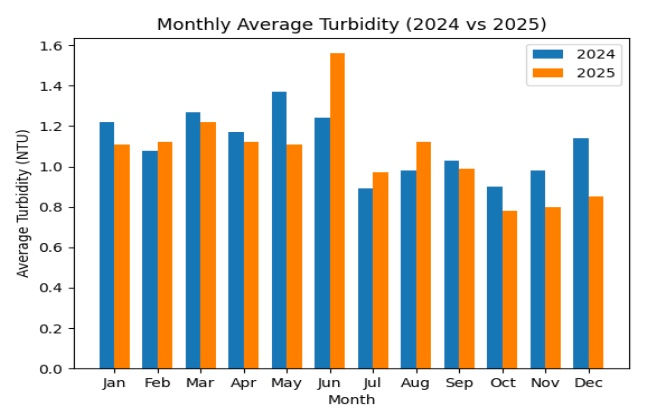
Further, monthly analysis in the chart below shows that turbidity in July and August (when boats are present) is below the annual average. In fact, turbidity levels are higher in the winter than in the summer. The raw data can be viewed in the file attached below.
Also note, that Canadian drinking water guidelines have a maximum acceptable concentration of 1.0 Nephelometric Turbidity Units (NTU) for drinking water as measured at delivery to the consumer. Lake Windermere is near or below this standard before treatment even starts!
Boat Launch Update
The District of Invermere (DOI) has been working very hard to get a permit for basic repairs to the boat launch near Pete's Marina. The concrete portion of the launch has been closed for three years, which forces boaters to use the adjacent dirt ramp which is in very poor condition. Unfortunately ?akisqnuk First Nation (AFN) is opposing the repair which has caused the BC Government to withhold the necessary permit. AFN has taken the additional step of requesting that DOI also close the adjacent dirt ramp to motorized vessels. The Lake Windermere Ambassadors have also lobbied to get the entire area closed to the launching of motorized boats. Fortunately, DOI has said they will not close the remainder of the area. DOI has spent vast sums of taxpayer money to satisfy First Nations and environmental requirements for this repair that is simple and non-invasive. They are trying to do what is right for the whole community. The BC Government normally processes applications, consults First Nations, and then makes a decision. We are concerned the BC Government is paralyzed to make any decision that is contrary to First Nations desires. The CVBA has written a letter to the Minister of Water, Land, and Resource Stewardship to support DOI and advocate for government policy that supports all residents.
Snowpack Data
The April 1 snowpack bulletin is the most important of the year. This is typically the peak snowpack of the year and tells us how much water is available to fill the lakes and rivers. A low snowpack also leads to increased risk of forest fires. After two years of abnormally low lake levels, things look really good this year. Our region (upper Columbia) was at 116% of normal, compared to 80% in 2025. BC as a whole is at 92% of normal, compared to 79% last year. It is best if the snow melts slowly through the spring, instead of quickly during an early heat wave. Click the button below to read the full report.
There are important developments in lake use regulation underway and more coming soon. The best way to protect access to the Lakes and your right to continue with recreational boating is to join the CVBA and stay informed by reading our newsletters. Please forward this newsletter to your friends who value the Lakes and encourage them to join the CVBA.


Comments